After a few days back in Buenos Aires doing things which I will post about later (no time to write, too busy doing things to write about), Rachael and I loaded our backpacks for a few days in Uruguay, which is just across the Rio de la Plata from Buenos Aires. To get there we had to catch a commuter ferry which left the docks at 8:00 a.m., but to get to the harbor we had to take the subway across the city, so we were trudging down the sidewalks at 6:00 a.m. This would have been no big deal, a typical day's commute, but remember this is Buenos Aires where dinner commonly starts at midnight and last night was no exception, so sleep, when it finally occurred, was between the glorious hours of 2 and 5 A.M. Let's just say we were a little less than bright-eyed and energized at the start of our journey.
The ferry ride was similar to an airline flight except the seats were less comfortable and the duty free shop was actually on the boat instead of in the port, so people could stock up on liquor and perfume and get drunk and then cover up the smell before they ever set foot in Uruguay (and not be taxed!).
I was fortunate enough to get a window seat but after staring out at the acres of brown waves I still hadn't figured out why it was called the "river of silver". I blame that on lack of sleep but there was no sleeping in the ferry unless one wanted to get whiplash from the choppy waves and the impossible non-proper-neck-supporting seats. Also I am not yet a jaded enough traveller to risk missing out on something by closing my eyes.
We set our feet in the country of Uruguay at Colonia del Sacramento. Colonia was founded by the Portuguese in 1680, taken over by the Spanish, then returned to Portugal, then back to Spain, and on and on until Uruguay achieved independence in 1828. It is the oldest city in Uruguay. The streets are cobbled and narrow, the architecture Spanish outside the historical Portuguese fort area and the whole city bordered by the river beaches of the Rio de la Plata.
Rachael and I picked up our rental car, grabbed a bite to eat at a small sidewalk cafe,wandered up and down some of the crooked lanes admiring the sights, fufilled our mandatory tourist requirements by photographing each other in front of various picturesque and crumbling walls,
 |
| Seeing something picturesque. |
and then decided to officially begin our Grand Adventure.
We reluctantly bought provisions in the form of a 3lb. cheese foisted upon us by an eccentric but wiley Uruguyan Phylis Diller look-alike who approached our car when we kindly stopped to let her cross the street, and then it was off to find the famous Plaza de Toros Real de San Carlos, a defunct bull fighting ring.
Rachael had remarked at the beginning of our trip that our only itinierary was to get lost and see the country. Someone had told her that Uruguay was such a small country one could drive around it in a day, so her biggest concern was what to do with all the spare time we would surely have. (Ok, for the record, someone either lied to Rachael or they mean't one could drive around a MAP of the country in a day, if it was laid out on the ground.) We did have a vague plan as we had hostel reservations in San Gregorio de Polanco, a small town in the middle of Uruguay for that night and for Montevideo several nights following.
In the end we did decide to buy a road map of the country, which turned out to be no easy task. It seems that all of Colonia had had a run on maps of Uruguay, and when we did finally obtain one it was a xeroxed and blurry edition with most of the names and hwy. numbers not quite legible.
The bullring was not on the map, but no worries, we just picked a road and there it was. It wasn't all that impressive, but WE were so impressed with ourselves for actually finding it that we felt our adventure enthusiasm revive despite lack of sleep! There were only 8 bullfights performed there before Uruguay outlawed bullfighting in 1912 so all you PETA members can breathe a sigh of relief (as can all you bulls).
The second and third times we "found" the bullring while actually trying to leave Colonia and head towards San Gregorio we were less impressed.
Evidently every road in Colonia leads to the bullring, though one would think that if the city was so intent on showing off this site, they would at least be enterprising enough to charge admission or set up a Red Bull stand or something. (Maps?!)
Eventually we managed to escape the endless bullring loop and we began heading into the Uruguyan interior.
The countryside of Uruguay is the South American twin to Alberta, Canada minus the freezing temperatures. There are miles of mostly flat green fields filled with sheep, horses, cows and nothing. Occasionally there is a house or a windmill, or a couple of trees. The sky is huge. There are a bazillion songbirds, When we pull over to pee in a bush, (there are also bushes), I am sure that the sound of all that singing at once would drive a proper birder into paroxysms of joy.
The landscape feels peaceful and a little desolate.
 |
Duck?
|
 |
| MOO! | | | | | |
 |
| MOO right back at you! |
We have consulted our map and San Gregorio de Polanco (not to be confused with San Gregorio de something else, which is along the way) does not seem too far away so we decide to avoid the pay-toll freeways and drive some of the smaller non-toll highways to our destination. This turns out to be a mistake. These "highways" are basically gravel lanes with car sized sinkholes every few feet. One assumes there is a lot of tractor traffic given the state of the roads but we don't pass anyone but the occasional motorcycle or scooter. Still we are enjoying the scenery, and confident that San Gregorio is just around the bend, we open the windows, throw back our heads and laugh like lunatics.
 |
| We should've rented this car . . . |
 |
| . . . because we were driving on this. |
|
|
 |
| 2 Lunatics |
Fast forward 10 hours...It is now midnight. We are sitting in a cafe NOT IN SAN GREGORIO DE POLANCO staring at our map which has gotten even more blurry over the last few hours. We have just found out that we are still at least 250 kilometers from our hostel. We somehow managed to drive in exactly the wrong direction for an hour and a half before realizing it and getting back on track. We also discoved once the sun went down that our headlights only work on the bright setting, so we are now personally responsible for blinding a huge percentage of the Uruguyan population. All the oncoming drivers would flash their lights to let us know our brights were on, and then, when we didn't politely dim them (which essentially turned them off) the oncoming drivers would flash us again and then in probable and justifiable fury they would bright US which, when you think about it, though it feels good to be vindicated, left EVERYONE blind, and thus doubled all of our chances to, as Dylan Thomas would say "not go gently into that good night". Suffice it to say that at this point, though we are still throwing back our heads and laughing, we are closer to becoming actual lunatics then just acting like them.
 |
| 3 Lunatics |
We have also learned something quaint about Uruguayan road signs; it is a given that any town shown on a map of Uruguay will NEVER be listed on a highway (non-toll rd) and if a town is
listed on a road sign, you can be sure you will never ever reach said town, nor will you pass any possible turn off which might lead you there. In fact you will only know you must've passed it because it will no longer appear on the roadsigns to tease you with promises of "almost there".
You might however end up at the bullring.
( NOTE FOR POTENTIAL TRAVELERS: this does not seem to hold true for the pay-toll freeways, so perhaps this is a well thought out plot and subtle inducement to use THOSE roads, which are clearly marked and well paved.)
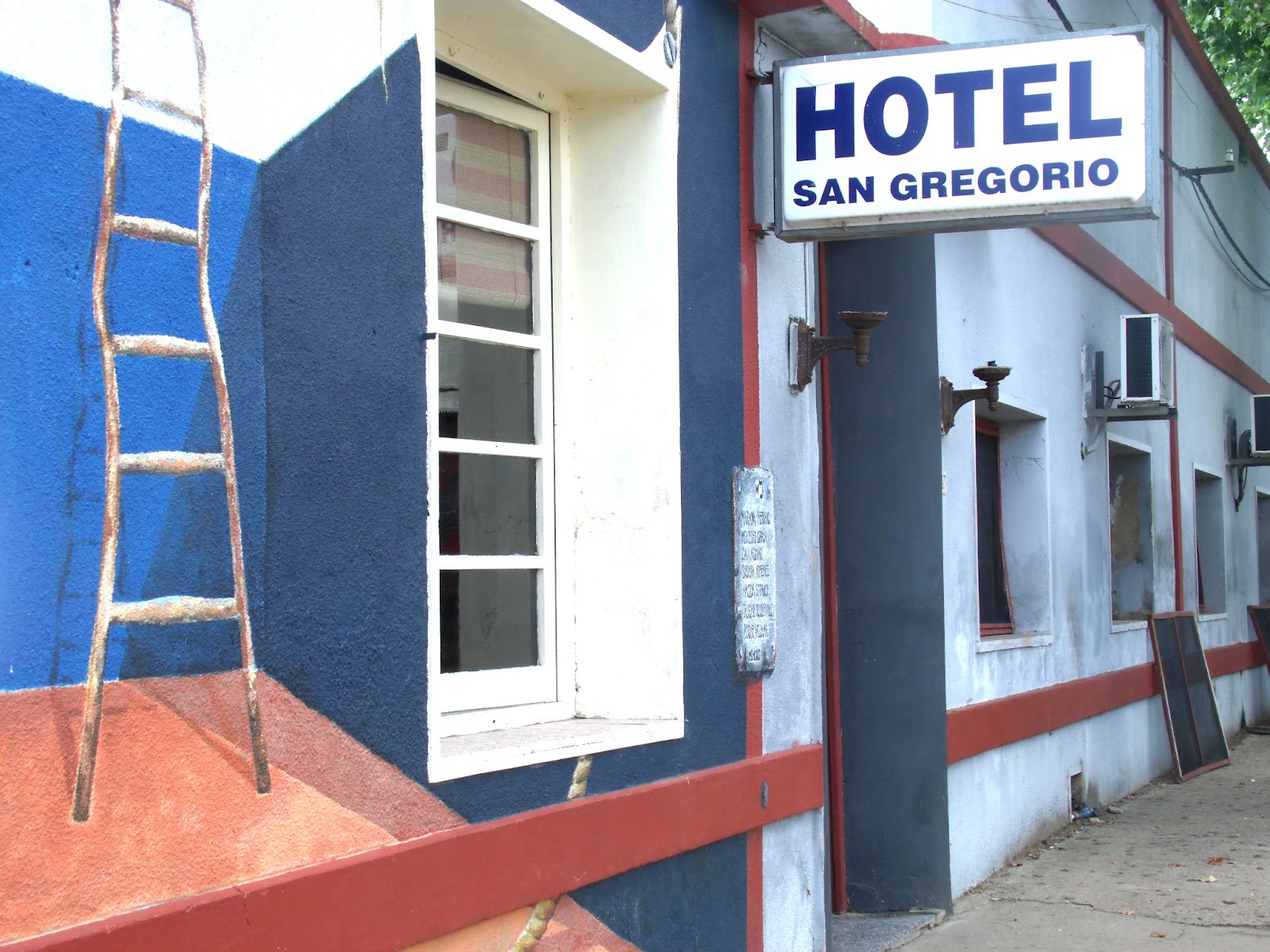
By some miracle of fate we did finally manage to roll into San Gregorio de P. at 2:30 A.M
and even in this tiny town we were able to find plenty of people congregating on the sidewalk, sipping mate and enjoying the gorgeous night, who could give us directions to our hostel.
After 12 hours of driving and 3 hours of sleep, I have to say, a bed has rarely looked so inviting!
Ciao for now,
J
San Gregorio De Polanco
View Larger Map